
Ir al contenido

Installation Basics Training (IBT)

Installation Basics Training (IBT) is GRID Alternatives’ foundational solar installation training program. Depending on where you train, IBT combines classroom instruction, hands-on lab practice, and real-world solar installation experience. Training is free, and many programs also pay you a stipend while you learn. There’s no experience requirement to apply.

  • Interstate Renewable Energy Council (IREC) Logo
  • NABCEP Logo
An installer in a hard hat and fall-arrest harness walks a metal roof between rows of newly mounted solar panels.
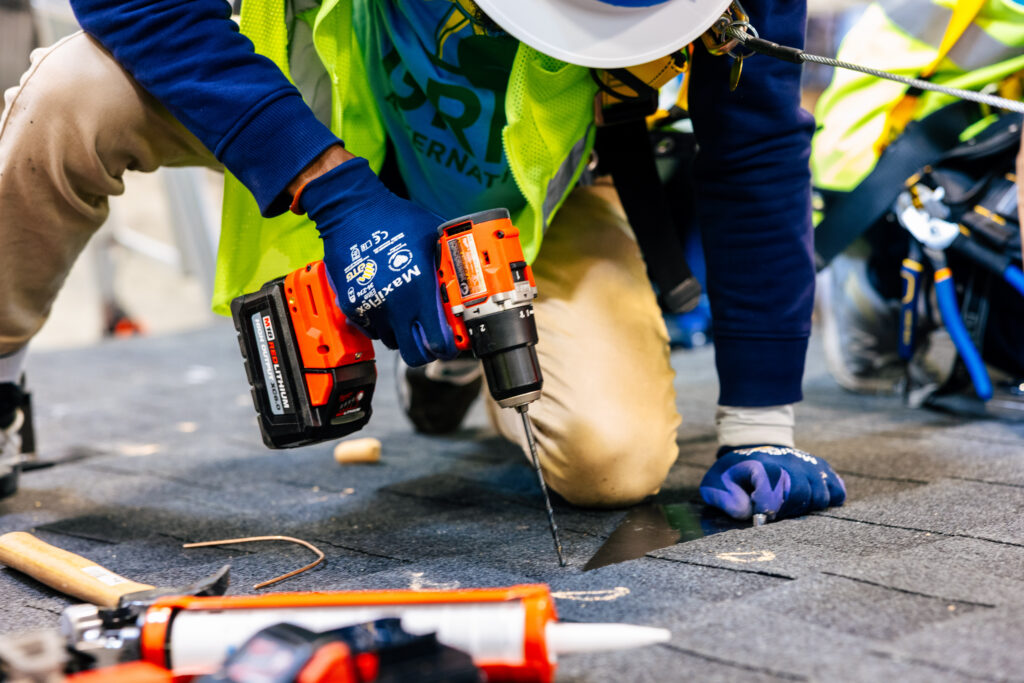
  • Construction worker in safety gear using cordless drill on roofing material during training
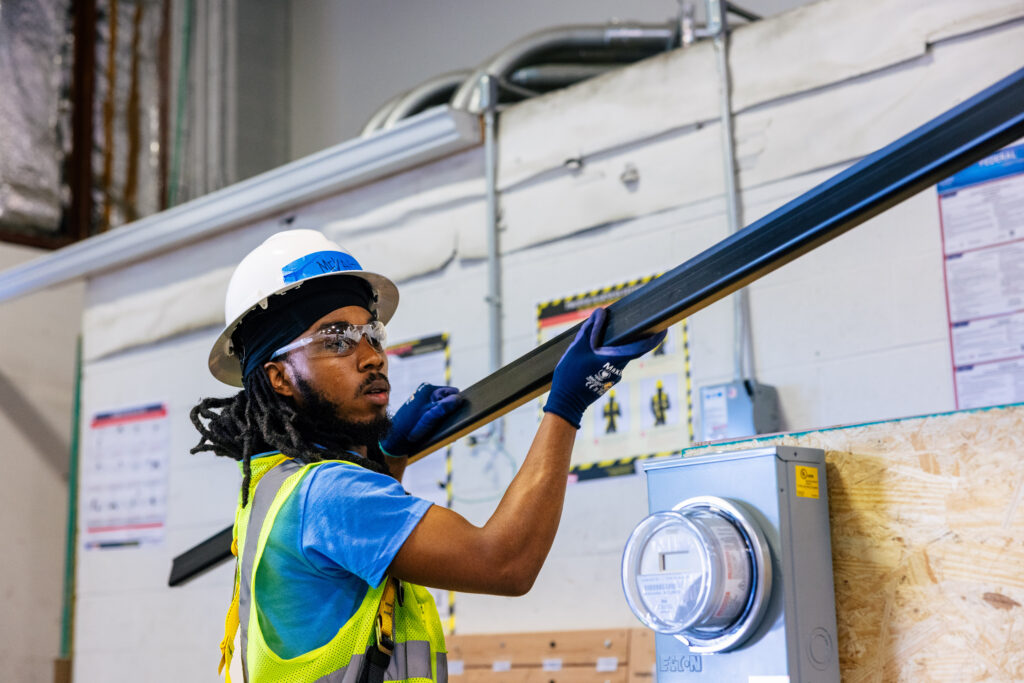
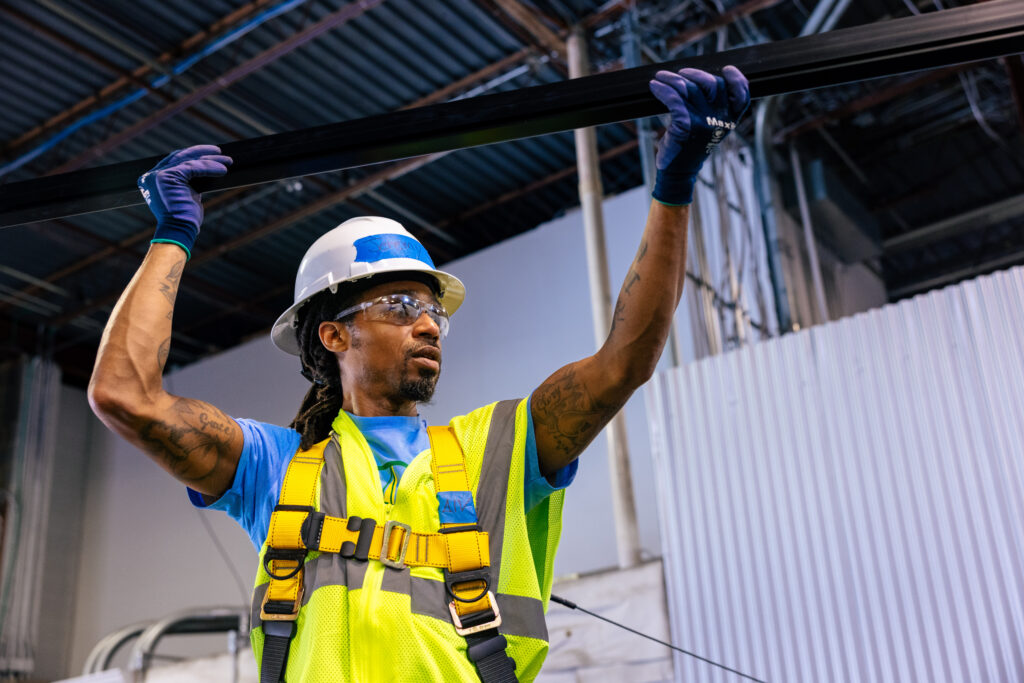
  • Construction worker in safety gear lifting steel beam overhead indoors
  • Man in red bandana and patterned shirt takes notes during classroom training session with four other participants seated at table
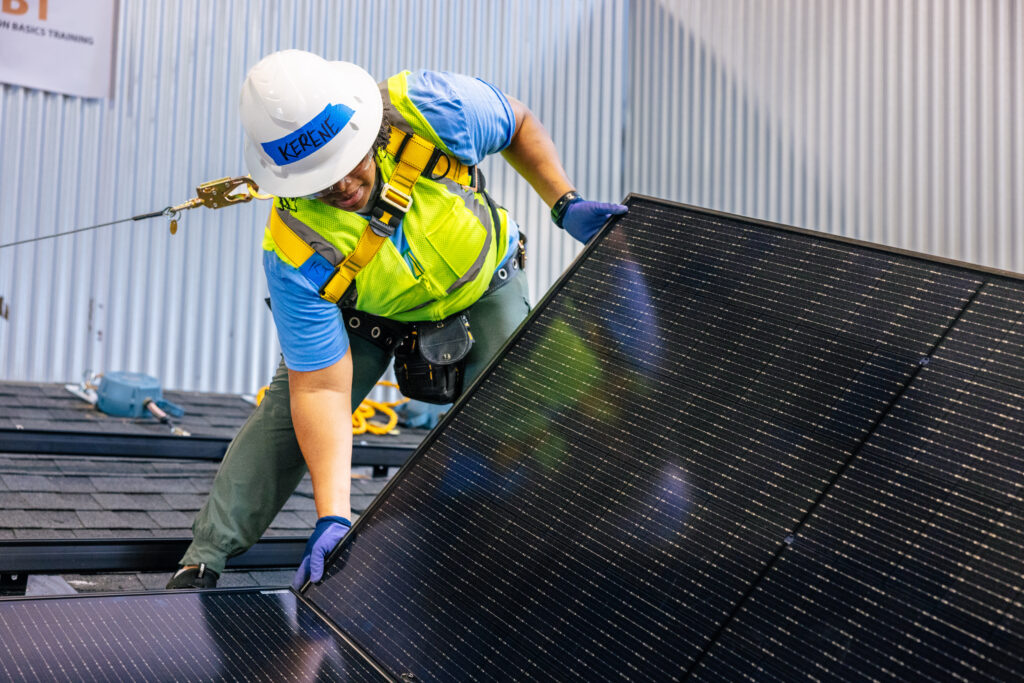
  • Worker in safety gear installing a solar panel on a rooftop

Certifications

  • NABCEP — IBT’s curriculum is based on the North American Board of Certified Energy Practitioners (NABCEP) PV Installer Specialist Job Task Analysis, a nationally recognized standard for solar installation training.
  • IREC — GRID’s IBT 200 program earned accreditation from the Interstate Renewable Energy Council (IREC) for our Central Valley and Inland Empire training centers, recognizing our commitment to safety, participatory learning, instructor-to-student ratios, and ongoing connection with industry.
Three workers in hard hats examine electrical wiring and cables during a training program

About the Program

Hands-on training, in the lab and on-site

Installation Basics Training (IBT) is GRID’s umbrella term for two training tracks: IBT Residential and IBT Commercial. IBT Residential is GRID’s established track, and includes two programs built on the same core curriculum, IBT 200 and IBT 120, both combining classroom learning with hands-on lab practice to prepare trainees for entry-level residential solar installation jobs.

Graduates of either program earn an IBT certificate of completion, plus OSHA-10 and CPR/First Aid certifications. IBT Commercial is a new track focused on commercial and multifamily solar installation.

Two ways to train

Every IBT program shares the same core curriculum and certifications. Choose the path that fits your goals: residential installation (the flagship course, offered in a 120- or 200-hour format by region) or commercial and multifamily installation for larger-scale work.

  • Now Enrolling

    IBT Residential

    • 200 or 120 hours
    • No cost
    • Paid in many regions

    GRID’s established training path, offered in two formats built on the same core curriculum:

    • IBT 200 — 200 hours over a minimum of five weeks. Combines classroom instruction, hands-on lab practice, and roughly 80 hours of real-world solar installation experience. Training is free, and many regions also provide a stipend.
    • IBT 120 — 120 hours of the same core curriculum, without the real-world installation component. Designed for community organizations and partners in regions without a GRID office, IBT 120 can be delivered directly by GRID’s traveling training team or taught by local instructors GRID trains through a train-the-trainer model.
    Explore IBT Residential
  • Launching Soon

    IBT Commercial

    • Commercial & multifamily focus
    • New

    Training focused on commercial and multifamily solar installation, building on the IBT foundation for trainees ready for larger-scale work.

Looking to run IBT at your own organization, or license the curriculum? See ways to partner

What to expect

From new to job-ready

Program length and structure vary by region and by whether you’re training in IBT 200 or IBT 120. Check your region’s details in Find a Program below.

  1. Students in a classroom taking notes during an educational session on a blue wall background

    Phase 1

    Safety & Foundations

    Orientation and safety training, including Occupational Safety and Health Administration (OSHA)-10 certification, implementing site safety plans, electrical safety, fall protection and ladder safety.

  2. Construction trainees in hard hats and safety vests listen to instructor during hands-on building training session

    Phase 2

    Tools & Construction

    Construction measurement and math, hand and power tool use, and framing basics like finding studs and rafters.

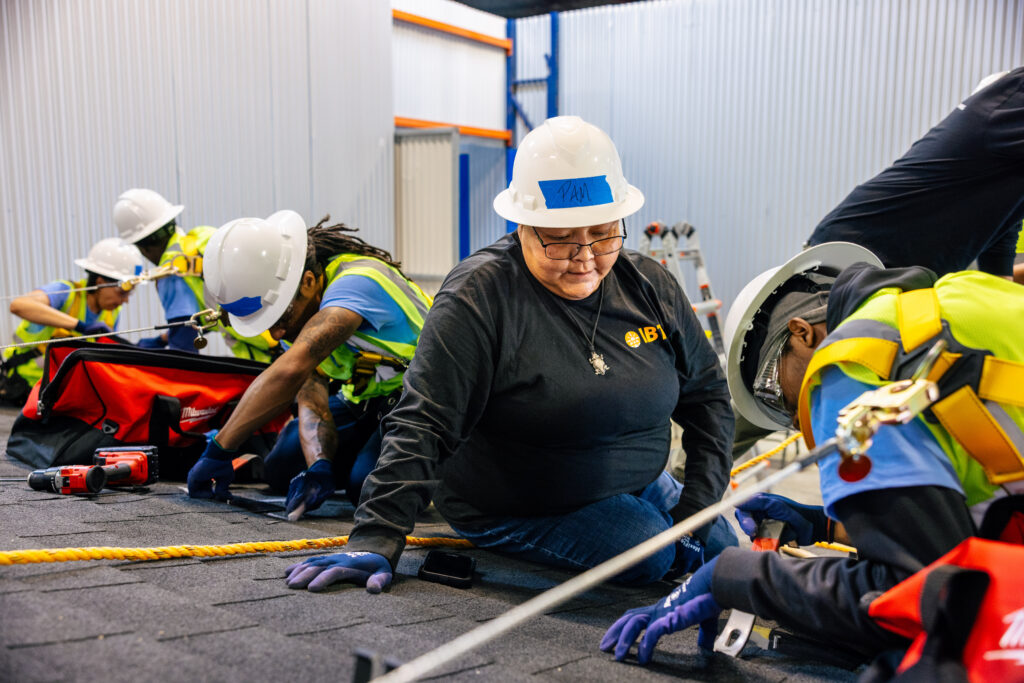
  3. Construction workers in safety gear practicing rope handling during IBT training in warehouse

    Phase 3

    Hands-On Installation

    Practice with array layout, mounting and racking, module and inverter installation, and conduit work.

  4. A trainee carries two large spools of electrical cable across a training bay.

    Phase 4

    Electrical & Systems

    Electricity basics, including series and parallel circuits, wire stripping and termination, crimping and splicing, and voltage testing, along with commissioning and quality-control checks.

  5. IBT trainee carrying equipment

    Phase 5

    Career Launch

    Employment readiness training, including resume building, mock interviews, customer service practice, time management, collaborative problem-solving, soft skills, and connections with employers who are hiring.

  • A trainee in a GRID T-shirt, hard hat and work gloves during a hands-on workshop session.
  • An instructor kneels on a practice roof deck demonstrating a technique to two trainees in high-visibility vests.
  • A trainee carries two large spools of electrical cable across a training bay.

Lo que aprenderás

Skills you’ll build.

You’ll learn everything you need to walk onto a solar job site and get to work. The curriculum covers six core areas, with hands-on practice built into every one.

  • Job Site Safety

    OSHA-10 requirements, job hazard analysis and site safety plans, fall protection and ladder safety, tool management, and electrical safety.

  • Construction Basics

    Construction measurement and math, and framing basics like identifying studs and rafters.

  • Electrical Wiring & Conduit

    Wire stripping, pulling, and termination; crimping and splicing; voltage testing; conduit bending and installation; and electrical layout and mounting.

  • Array Installation

    Array layout, mounting and racking, module and inverter installation, module-level power electronics (MLPE) installation, and supply staging and packing.

  • Commissioning & O&M

    Site evaluation using tools like the SunEye, and quality-control checks to confirm the system is working correctly and ready for inspection.

  • Employment Readiness

    Resume building, mock interviews, customer service practice, job fairs, and direct connections with employers who are hiring.

IBT’s curriculum is based on the NABCEP PV Installer Specialist Job Task Analysis, and GRID’s Central Valley office is accredited for IBT 200 by the Interstate Renewable Energy Council (IREC).

  • Three seconds after graduating from GRID’s IBT program, I was hired as a solar installer. The OSHA-10 certificate was a deal sealer. He hired me on the spot.

    Ryan Arango

    Director of Asset Management | Preservation Equity Fund Advisors

  • I can’t believe I’m working in the solar industry. I remember when an IBT 200 trainee came to my class and received his tools for his new job. Now here I am receiving my tools and encouraging the next cohort to keep learning, and you too will find success in the solar industry.

    Montrail Lowe

    IBT Graduate

  • If it wasn’t for this program, I don’t know where I would be. Thank you for this opportunity!

    Daniel Garcia

    IBT Graduate

  • The vibe was awesome! Everyone was so positive and hardworking.

    Anthony

    IBT Graduate | GRID San Diego

  • I recommended this program to many people I know. There are no other programs like this.

    Leighton Nelson

    IBT Graduate

  • The instructors were extremely knowledgeable and led me to want to learn more about the solar industry and electricity. Following the training, I decided to pursue a path toward a career in solar.

    Krizia Karry

    IBT Graduate

  • My experience with GRID has changed my life. I gained knowledge and obtained a skill that will benefit my family.

    Chris Brown

    IBT Graduate

  • In a short amount of time GRID was able to teach me the fundamentals of installations and through their networking put me in an interview that led to my first position in the solar industry.

    Herson Fuentes

    IBT Graduate

Worker in safety harness and hard hat on roofing structure against blue sky

Cost & What’s included

It’s 100% covered. Here’s what you get.

IBT is offered at no cost. Some programs also pay you a stipend while you train.

Included at no cost

  • Full IBT training (classroom, lab, and, for IBT 200, real-world installation)
  • IBT certificate of completion
  • OSHA-10 certification
  • CPR/First Aid certification
  • Personal protective equipment for training and job sites
  • Resume-building and job search support
  • Direct connections to employers who are hiring

What you need to apply

  1. 18 years of age or older
  2. Basic English comprehension, including the ability to follow spoken safety instructions
  3. Authorization to work in the U.S.
  4. Ability to do physical training and job tasks: standing for long periods, bending, lifting up to 50 pounds, and working outdoors, including on rooftops. Reasonable accommodations are available.
  5. Motivation to work in the solar or related industries

Need help with transportation or childcare? Some sites offer additional wraparound support through local partner organizations. Ask your regional office or partner site what’s available when you apply.


Find a program

Find an IBT program near you.

Pick the region closest to you to see the program and request information. Cohorts run throughout the year; a member of the regional training team will follow up with current start dates and next steps.

Filter by

Where We Work

  • GRID training regions
  • Partner-delivered Locations
GRID training regions

GRID IBT - Oakland

Oakland

(510) 241-3389 trainingba@gridalternatives.org

5-week, 200-hour program
Mon–Fri, 8am–5pm · Up to 12 per class

Learn More
GRID training regions

GRID IBT - Sacramento

Sacramento

(209) 457-8902 trainingnv@gridalternatives.org

5-week, 200-hour program
Mon–Fri, 8am–5pm · Up to 12 per class

Learn More
GRID training regions

GRID IBT - Fresno

Fresno

(559) 214-0204 trainingcv@gridalternatives.org

5-week, 200-hour program
Mon–Fri, 8am–5pm · Up to 12 per class

Learn More
GRID training regions

GRID IBT - Los Angeles

Los Angeles

(310) 579-9193 traininggla@gridalternatives.org

8-week, 200-hour program
Mon–Fri, 8am–1pm · Up to 15 per class

Learn More
GRID training regions

GRID IBT - Riverside

Riverside

(951) 608-1042 trainingie@gridalternatives.org

8-week, 200-hour program
Mon–Fri, 8am–1pm · Up to 15 per class

Learn More
GRID training regions

GRID IBT - San Diego

San Diego

(619) 610-0165 trainingsd@gridalternatives.org

8-week, 200-hour program
Mon–Fri, 8am–1pm · Up to 12 per class

Learn More
GRID training regions

GRID IBT - Denver

Denver

(303) 481-4381 trainingco@gridalternatives.org

5-week, 160-hour program
Mon, Tue, Thu, Fri, 8am–5pm · Up to 12 per class

Learn More
GRID training regions

GRID IBT - Tribal Nations

Portland and other locations

(702) 276-2200 trainingtribal@gridalternatives.org

3-week, 120-hour program
Mon–Fri, 8am–5pm · Up to 15 per class

Learn More
GRID training regions

GRID IBT - Washington, D.C.

Washington, D.C.

(202) 517-8848 trainingdc@gridalternatives.org

3-week, 120-hour program
Mon–Fri, 8am–5pm · Up to 15 per class

Learn More
GRID training regions

GRID IBT - Puerto Rico

Juncos, Yabucoa

(787) 699-3601 PuertoRico@gridalternatives.org

3-week, 120-hour program
Mon–Fri, 8am–5pm · Up to 12 per class

Learn More
Partner-delivered Locations

Goodwill of Middle Tennessee

Nashville, TN

(615) 742-4151 training@givegw.org

120-hour IBT within a 160-hour program
Part of the Goodwill CleanTech Accelerator (GCTA)

Learn More(este enlace se abrirá en una nueva ventana)
Partner-delivered Locations

Goodwill of New Mexico

Albuquerque, NM

(505) 881-6401

120-hour IBT within a 160-hour program
Part of the Goodwill CleanTech Accelerator (GCTA)

Learn More(este enlace se abrirá en una nueva ventana)
Partner-delivered Locations

Goodwill of Houston

Houston, TX

(832) 900-7472 DHulin@goodwillhouston.org

120-hour IBT within a 160-hour program
Part of the Goodwill CleanTech Accelerator (GCTA)

Learn More(este enlace se abrirá en una nueva ventana)
Partner-delivered Locations

Goodwill-Easter Seals Minnesota

St. Paul, MN

(651) 379-5800 cleantech@gesmn.org

120-hour IBT within a 160-hour program
Part of the Goodwill CleanTech Accelerator (GCTA)

Learn More(este enlace se abrirá en una nueva ventana)
Partner-delivered Locations

Goodwill Columbus

Columbus, OH

(614) 294-5181 amanda.lynne@gwcols.com

120-hour IBT within a 160-hour program
Part of the Goodwill CleanTech Accelerator (GCTA)

Learn More
Partner-delivered Locations

Goodwill of South Florida

Fort Lauderdale, FL

(954) 486-1600 training@goodwillmiami.org

120-hour IBT within a 160-hour program
Part of the Goodwill CleanTech Accelerator (GCTA)

Learn More
Partner-delivered Locations

Goodwill of Colorado

Aurora, CO

(719) 635-4483 cleantech@goodwillcolorado.org

120-hour IBT within a 160-hour program
Part of the Goodwill CleanTech Accelerator (GCTA)

Learn More(este enlace se abrirá en una nueva ventana)
Partner-delivered Locations

Amplify Chicago

Chicago, IL

(773) 270-8190 info@amplifychicago.org

120-hour IBT within a 12-week program

Learn More(este enlace se abrirá en una nueva ventana)
Partner-delivered Locations

Community Atlanta Solar Team (C.A.S.T.)

Atlanta, GA

ariel@blacksustainability.org

120-hour IBT within a 160-hour program

Learn More(este enlace se abrirá en una nueva ventana)
Partner-delivered Locations

Elevate Energy

Chicago, IL

120-hour IBT within a 10-week program

Partner-delivered Locations

Clackamas Community College

Portland, OR

120-hour IBT

FAQ

Common Questions

Yes. There’s no tuition, and all training materials and certifications are included. Many programs also pay you a weekly stipend while you train. Exact pay varies by region. The costs are typically covered by local or state grant programs for you.

No. IBT is designed for people with no construction or electrical background. Eligibility depends on meeting the requirements listed above, not on prior experience.

GRID welcomes trainees from all backgrounds, including people who have been impacted by the criminal justice system. A record does not automatically disqualify you.

Most programs run full-time, five days a week, based on the standard program schedule. If you’re working full-time, you may need to take time off during training.

GRID provides direct employer connections, hosts job fairs and solar showcases, and connects you to paid project-based work through our network of subcontractors. Over half of IBT graduates report their experience at GRID helped them get a job. 70% of graduates who report employment are working in solar or related industries.