Solar for your home
Check eligibility
or call (866) 921-4696
GRID Alternatives has been selected as the administrator of the Disadvantaged Communities – Single-Family Solar Homes (DAC-SASH) program. This California state program provides $8.5 million in incentives annually to help homeowners in disadvantaged communities go solar.

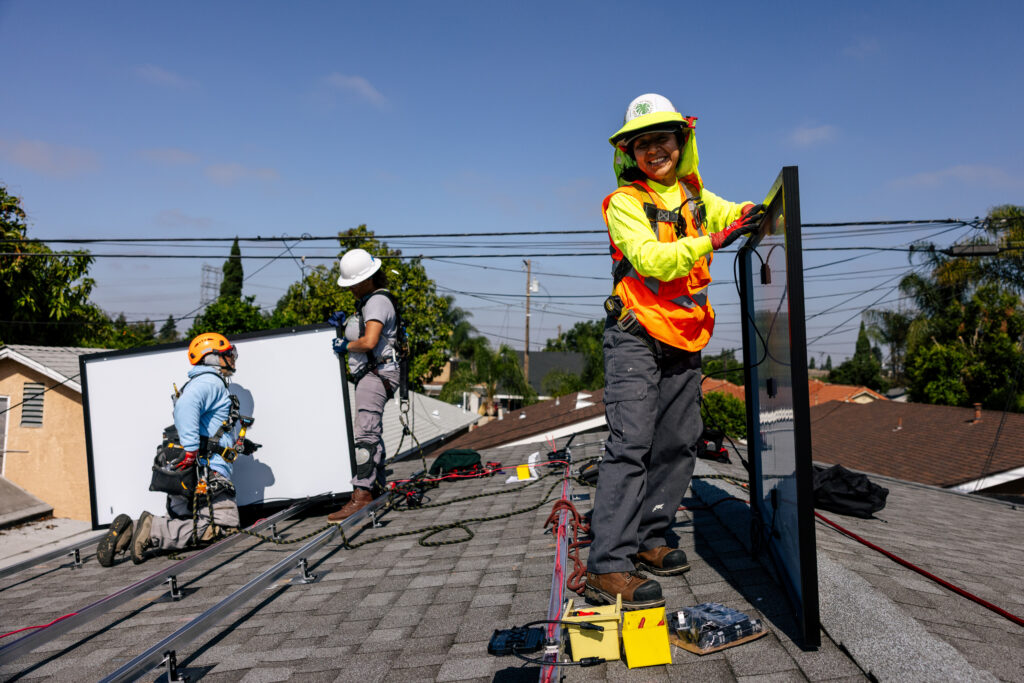
DAC-SASH is a program approved by the California Public Utilities Commission (CPUC) to increase the adoption of clean, affordable solar by residential customers living in disadvantaged communities. It runs through 2030, and is modeled after California’s long-standing Single-family Affordable Solar Homes (SASH) program. The DAC-SASH program integrates job training opportunities into every project, creating ladders of opportunity for people from all backgrounds to access well-paid jobs in California’s solar industry and ensuring lasting community impact.
Maximize financial savings
For income-qualified households in communities facing economic and environmental hardship.
Long-term self-sufficiency
Connecting community members to green job training and solar employment opportunities that build lasting economic independence.
Consumer protection
Protecting participants and ensuring lasting benefits throughout the life of the program.
Education
Sharing information on energy efficiency and other programs that can help families save even more.
Robust participation
Ensuring broad participation and access for households served by PG&E, SCE, and SDG&E.
Eligible applicants must meet ALL of the following criteria:
Must receive electrical service from Pacific Gas & Electric (PG&E), Southern California Edison (SCE), or San Diego Gas & Electric (SDG&E)
Must own and occupy a single-family home as the applicant’s primary residence
The residence must be located in a disadvantaged community (DAC) identified by the CalEnviroScreen 4.0 map (only homes in the red areas qualify)
Total household income must not be more than CARE or FERA program limits

| People in Household | Maximum Household Annual Income |
|---|---|
| 1–2 | $54,100 |
| 3 | $68,300 |
| 4 | $82,500 |
| 5 | $96,700 |
| 6 | $110,900 |
| 7 | $125,100 |
| 8 | $139,300 |
Think you qualify? Complete the online eligibility form or call GRID Alternatives toll-free at (866) 921-4696 to coordinate a pre-screening phone conversation.
or call (866) 921-4696